

 +8618733132385
 +8618733132385



Four Major Manganese Ore Beneficiation Processes
2026-04-30 Xinhai (239)

2026-04-30 Xinhai (239)
If you have any questions, please contact us through the following ways, we will give you more and better assistance!

Manganese ore is an indispensable key raw material in the metallurgical industry. With the continuous development of China’s metallurgical sector, the consumption of manganese ore has been increasing year by year, with manganese carbonate ore being the primary type of manganese ore in the country. In manganese ore beneficiation, single-process technologies are widely applied, primarily including washing, gravity separation, magnetic separation, and flotation. These processes differ significantly in their applicable scenarios, advantages, and disadvantages. The following provides a detailed introduction.
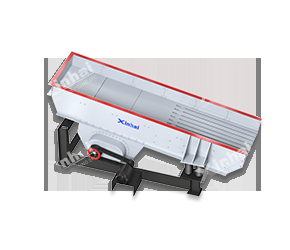
Ore washing is the most traditional and fundamental process in manganese ore beneficiation, typically carried out in conjunction with screening operations. In actual production, there are two primary methods: first, the raw ore is screened using a vibrating screen while being washed with water; second, the ore is washed to obtain clean ore, which is then processed through a vibrating screen for classification.
Ore washing is an essential pre-treatment step in manganese oxide beneficiation plants. The manganese-rich ore produced after washing can directly meet metallurgical requirements. Characterized by a simple process and low operating costs, it is primarily used to remove impurities such as clay and sludge, thereby creating favorable conditions for subsequent separation.
Manganese ore gravity separation relies on differences in mineral density to achieve separation. Commonly used equipment includes jigs (for processing coarse and medium-sized ore) and shaking tables (for processing fine-grained material). This process requires low capital investment and has low operating costs; it is the preferred choice when there are significant differences in the density of gangue minerals.
Gravity separation requires proper control of grinding fineness; excessive grinding increases separation difficulty and reduces recovery rates. In production, strict control of particle size is typically implemented to enhance separation efficiency and metal recovery rates.
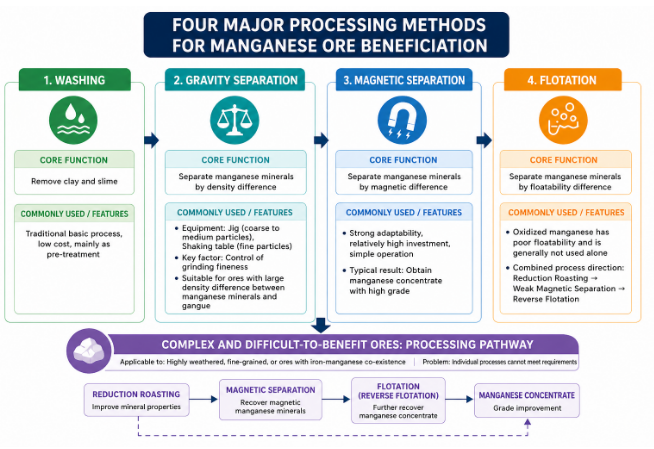
Magnetic separation is a traditional process for separating manganese ore using magnetic equipment. Although it has the drawback of relatively high capital investment, its advantages are significant: low production consumption, simple operation, easy equipment control, and strong adaptability. It can process various types of manganese ore and is currently widely used in the industry.
In actual production, using a Φ750 classifier for manganese ore magnetic separation yields concentrate specifications of 42.3% grade and 66.51% recovery rate, with good separation stability.
Flotation is a conventional mineral processing method; however, manganese oxide ores have poor floatability. Therefore, standalone flotation is rarely used and is typically combined with processes such as magnetic separation.
For highly weathered, clay-like, and extremely fine-grained high-iron-manganese-to-iron-manganese co-existing ores, single-process gravity separation, magnetic separation, or flotation alone cannot meet the required standards. Industrially, the following combined processes are commonly adopted: magnetic reduction roasting — weak magnetic separation — iron tailings reverse flotation. This process yields high-quality manganese concentrate with a grade of 34.55% and a recovery rate of 78.47%, providing an efficient solution for complex, difficult-to-process manganese ores.


 Consult
 Message
 Email
Email