

 +8618733132385
 +8618733132385



Gravity Separation and Flotation Processes for Cassiterite
2026-04-30 Xinhai (265)

2026-04-30 Xinhai (265)
If you have any questions, please contact us through the following ways, we will give you more and better assistance!

The method of cassiterite beneficiation is closely related to its particle size. Coarse-grained cassiterite is generally processed using gravity separation; however, gravity separation equipment has limitations regarding the applicable particle size range. At the same time, cassiterite ore often contains complex associated components with similar mineral properties, making separation difficult. Additionally, issues such as high clay content and ion adsorption can affect the floatability of cassiterite and the efficiency of the separation process.
Gravity separation is the mainstream process for cassiterite beneficiation. It relies on the density difference between cassiterite and gangue minerals to achieve separation through the combined action of water flow and mechanical force, offering advantages such as low cost and environmental friendliness. Advances in cassiterite gravity separation technology are closely linked to upgrades in equipment such as shaking tables, centrifugal separators, and jigs, which directly determine recovery rates and economic benefits. In actual production, the gravity separation process must adhere to the principles of “recovering early what can be recovered, discarding early what can be discarded, separating the easy from the difficult, separating the rich from the poor, and separating by particle size,” balancing the issues of mineral liberation and overgrinding to improve overall separation efficiency.
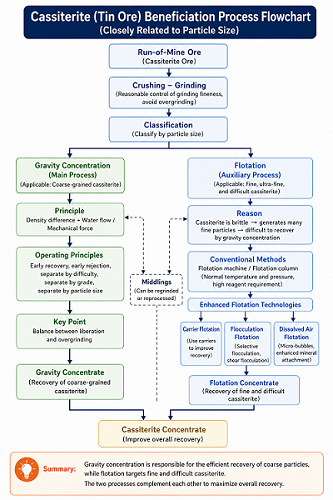
Flotation is primarily used as a supplementary process to gravity separation, serving to recover fine and ultrafine particles of difficult-to-separate cassiterite. Cassiterite is brittle, and the grinding process tends to generate a large amount of fine particles, making efficient recovery difficult through conventional gravity separation; flotation can effectively address this shortcoming.
Currently, cassiterite flotation primarily relies on conventional methods, utilizing flotation machines and flotation columns to achieve concentration under ambient temperature and pressure. While this approach is simple to operate and easy to implement, it places high demands on the reagent regime. In addition, the industry has developed various flotation enhancement technologies: carrier flotation utilizes minerals with similar floatability as carriers to carry fine-grained cassiterite to the surface; flocculation flotation is divided into selective flocculation and shear flocculation, which improve the floatability of fine-grained cassiterite through agglomeration; dissolved air flotation generates microbubbles of 20–100 μm in size, significantly improving the adhesion and separation efficiency of fine-grained cassiterite.
Overall, gravity separation and flotation complement each other: gravity separation is responsible for the efficient recovery of coarse-grained cassiterite, while flotation focuses on fine-grained, difficult-to-process cassiterite. The combination of the two maximizes the overall recovery rate of cassiterite, meeting the industrial production demands of complex cassiterite ores.


 Consult
 Message
 Email
Email