

 +8618733132385
 +8618733132385



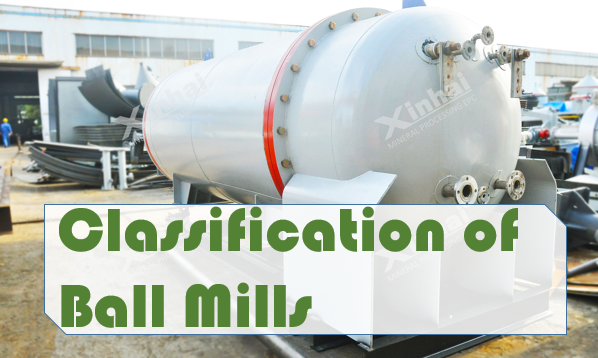
Classification of Ball Mills
2026-02-28 Xinhai (357)

2026-02-28 Xinhai (357)
If you have any questions, please contact us through the following ways, we will give you more and better assistance!

The ball mill is the core grinding equipment in the beneficiation industry, including gold ore, lithium ore, non-metallic ore and other mines. Its main function is to further grind crushed ore into fine particles so that valuable minerals are fully liberated, creating conditions for flotation, gravity separation, magnetic separation and other separation operations. Ball mills feature mature structure, strong adaptability and stable operation. According to different classification methods, they can be divided into various types and are widely used in the mining industry.
According to cylinder shape and length, ball mills can be divided into short-cylinder ball mills and long-cylinder ball mills. Short-cylinder ball mills are short, high-yield and suitable for coarse grinding. Long-cylinder ball mills provide longer grinding time and finer products, mostly used for fine grinding to effectively improve mineral liberation, and are widely used in gold processing plants.
According to grinding method, they are divided into dry ball mills and wet ball mills. Dry ball mills grind without water, suitable for arid areas or moisture-sensitive materials. Wet ball mills grind with water, featuring higher efficiency, more uniform particle size and less blockage, making them the mainstream choice for gold and non-ferrous metal ore beneficiation.
According to discharge method, common types include overflow ball mills and grate ball mills. Overflow ball mills have simple structure and discharge naturally through pulp overflow, producing fine particles ideal for fine grinding. Grate ball mills are equipped with discharge grates for forced discharging, featuring high flow rate, large capacity and less over-grinding, mostly used for coarse grinding, especially in closed-circuit grinding with hydrocyclones.
According to transmission mode, they can be divided into edge-driven ball mills and center-driven ball mills. Edge-driven ones feature simple structure, low cost and convenient maintenance, commonly used in small and medium-sized plants. Center-driven ones have higher efficiency and smoother operation but higher cost, mostly applied in large modern processing plants.
In gold ore production, the most commonly used are wet overflow ball mills and wet grate ball mills. Grate types are often used in primary grinding for large capacity and high efficiency, while overflow types are preferred in secondary grinding to ensure fineness and improve gold liberation, thus enhancing flotation recovery.
Reasonable classification and selection of ball mills directly affect grinding efficiency, energy cost and final beneficiation indicators. Choosing the right ball mill can effectively improve valuable mineral recovery, reduce production costs, and is an important part of beneficiation process optimization.


 Consult
 Message
 Email
Email