

 +8618733132385
 +8618733132385



Beneficiation Process for Primary Lead-Zinc Ore
2026-04-30 Xinhai (255)

2026-04-30 Xinhai (255)
If you have any questions, please contact us through the following ways, we will give you more and better assistance!

As important non-ferrous metals, lead and zinc are widely used across various sectors of the national economy, and they occur in close association in nature. The beneficiation of primary lead-zinc ores requires a systematic process to achieve the separation and purification of lead and zinc. The core process is primarily divided into three stages: grinding and classification, separation, and dewatering. These stages are adapted to ores with different grain size distributions to ensure the production of qualified lead-zinc concentrates.
Grinding and classification constitute a critical preliminary stage in mineral processing, with the choice of process depending on the grain size of the ore and the complexity of the mineral association: ores with a coarser grain size and simple mineral associations are processed using single-stage grinding, whilst those with a finer grain size and complex mineral associations are processed using two-stage grinding. The core equipment for grinding is the ball mill, whilst classification equipment primarily comprises spiral classifiers and hydrocyclone banks. Grinding and classification achieve individual liberation of minerals, laying the foundation for subsequent separation.
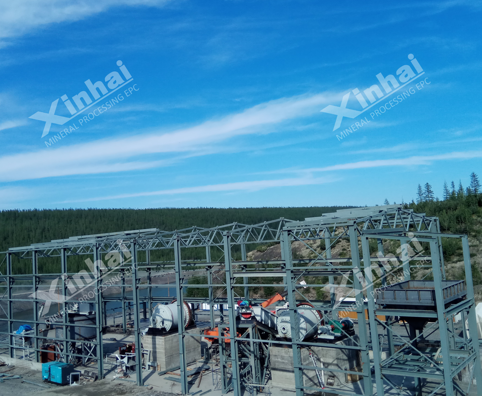
The beneficiation stage is dominated by flotation, which is the core process for separating lead and zinc. Three distinct flotation flowsheets are selected based on the type of ore: the priority flotation process is commonly used for lead-zinc-sulphide ores, with flotation carried out in the sequence ‘lead → zinc → sulphide’ to produce lead concentrate and zinc concentrate, whilst the sulphide concentrate is discarded as tailings; The partial mixed flotation process is suitable for copper-lead-zinc ores. It involves first flotating copper and lead together to produce a mixed concentrate, followed by zinc flotation, and finally separating the copper-lead mixed concentrate to obtain copper and lead concentrates; The sequential flotation process is designed for complex polymetallic ores containing both easily and difficult-to-float minerals. Flotation is carried out in order of floatability, from easiest to most difficult, ultimately yielding qualified concentrates. Common separation equipment includes flotation cells and high-efficiency agitation tanks.
The dewatering stage is the final step in product formation, primarily involving the dewatering of the separated lead-zinc concentrate. Common equipment includes thickeners, vacuum filters and filter presses; the concentrate, after dewatering, is easier to store, transport and process in subsequent smelting operations.
The entire process is suitable for various types of primary lead-zinc ores. It is a mature and highly efficient separation process, and represents the core technology for the efficient recovery of lead and zinc resources.


 Consult
 Message
 Email
Email