

 +8618733132385
 +8618733132385



Complete Process of Gold Mining and Beneficiation
2026-01-23 Xinhai (724)

2026-01-23 Xinhai (724)
If you have any questions, please contact us through the following ways, we will give you more and better assistance!

The implementation phase of gold mining constitutes the core of the entire process, with the primary task being the extraction of gold ore from the surface or underground. The burial depth and geological conditions of the gold deposit determine the selection of mining methods. Based on the specific characteristics of the mining area, mining methods are categorized into open-pit mining and underground mining.
Open-pit mining is suitable for areas with prominent gold outcrops or shallow deposits. Heavy machinery first enters the site to strip away surface soil and overburden rock to expose the ore body. Subsequently, excavators and loaders work in tandem to continuously transport the ore to the surface.
Underground mining becomes the rational choice when gold outcrops are scarce or deposits lie deep underground. Implementing underground mining requires first excavating access tunnels near the ore body to establish auxiliary systems for transportation, ventilation, and other functions. Subsequently, preparatory mining operations within the ore body—such as rock drilling and ore caving—are completed. Mining technology is then employed to transport the ore from the working face to the loading area outside the shaft.
Ore processing and refining are critical stages for extracting gold from mined ore, encompassing crushing, grinding, beneficiation, smelting, and refining. These interconnected processes work together to extract gold from the raw ore.
Gold ore is first crushed into small particles, then ground to a finer state to adjust particle size and enhance efficiency in subsequent beneficiation and smelting. Equipment primarily used in this stage includes jaw crushers, cone crushers, and ball mills.
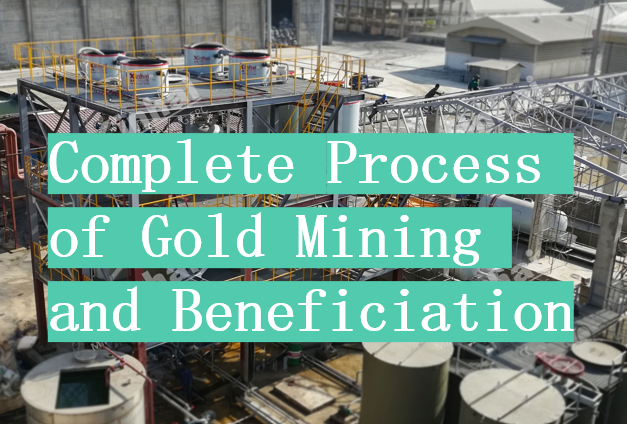
Beneficiation essentially involves separating the valuable components of the ore from the waste gangue to produce gold concentrate. Common methods include gravity separation, flotation, and cyanidation. Gravity separation relies on density differences between metals, flotation utilizes variations in mineral surface chemistry, while cyanidation dissolves metallic ions through reaction with sodium cyanide solutions for extraction.
The purpose of smelting and refining is to separate and purify gold from other metals within the gold concentrate. This process typically follows two distinct pathways: pyrometallurgical and hydrometallurgical methods.
Gold mining and mineral processing form an interconnected, technology-intensive continuous process. Whether scientifically selecting open-pit or underground mining methods based on ore body conditions, or progressively refining through crushing, grinding, mineral processing, smelting, and refining, each stage aims to maximize resource recovery rates and economic value.


 Consult
 Message
 Email
Email